
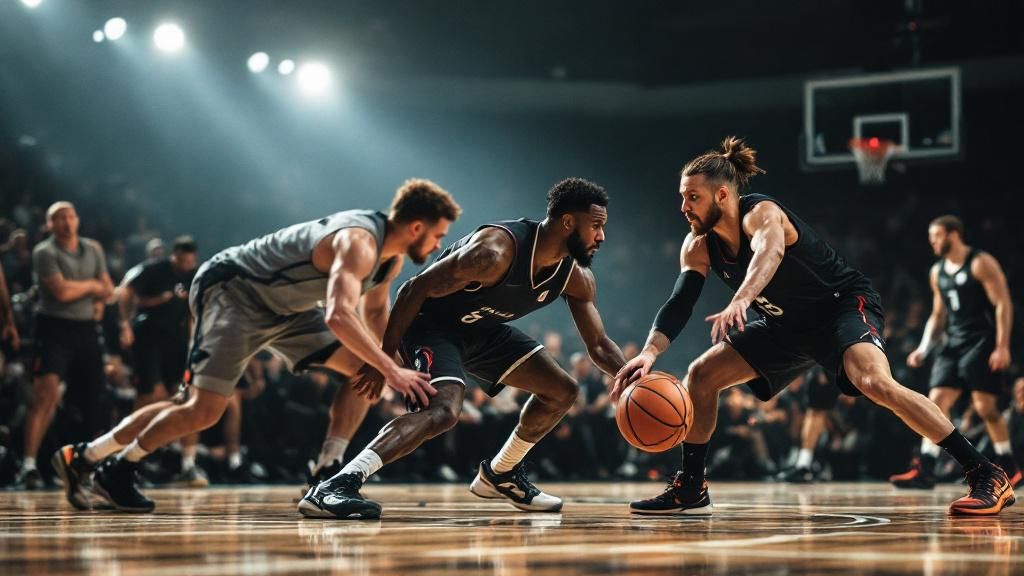
The pick and roll remains basketball’s most effective offensive asset, yet only the top-tier point guards genuinely master its intricate nuances. From Stephen Curry’s exceptional spacing to Luka Dončić’s resourceful finishing, the top playmakers orchestrate this essential play with outstanding sophistication. This article examines the elite strategies that separate elite orchestrators from the rest, assessing how world-class creators manipulate defences, generate scoring chances, and maintain competitive dominance through refined pick and roll application at the top tier.
Understanding the Essential Basics of Pick-and-Roll Play Mastery
The pick and roll constitutes basketball’s most essential and deeply effective attacking play, acting as the cornerstone of modern play-calling at the highest levels. Mastering this partnership play necessitates sophisticated comprehension of spacing, timing, and defensive recognition. Leading playmakers comprehend that effective implementation goes beyond mere mechanical repetition; it requires nuanced interpretation of defensive alignment and immediate decision-making. The best practitioners utilise the pick and roll not just as a means of scoring, but as a multi-purpose weapon for creating benefits that ripple throughout entire offensive systems, producing further openings for teammates and forcing defensive rotations that expose vulnerabilities.
Championship-calibre point guards distinguish themselves through their capacity to control pick and roll variables with exceptional accuracy and inventiveness. They understand that screen angles, roll timing, and decision-making speed critically shape outcomes against complex defensive strategies. Understanding defensive coverages—whether switching, hedging, or pressing—allows top-tier facilitators to anticipate opponent reactions and exploit gaps accordingly. The foundation of excellence lies in recognising that the pick and roll’s true power emerges from blending technical skill with game understanding, enabling point guards to orchestrate offences with authority and consistently generate high-percentage scoring opportunities that maintain a winning edge throughout challenging campaigns.
Perfecting Spacing and Positioning Strategies
Elite point guards grasp that spacing and positioning create the basis of efficient pick and roll execution. By keeping optimal distance from teammates and the ball handler, guards open up passing lanes that defenders struggle to defend. The most experienced playmakers position themselves to exploit defensive weaknesses, driving defenders into awkward movements. This tactical understanding allows them to read defensive reactions milliseconds faster than their opponents, enabling precise decision-making that separates elite performers from competent players in high-pressure competitive environments.
Positioning goes beyond basic floor positioning; it includes anticipating defensive movements and modifying tactics. Championship-level point guards constantly evaluate floor geometry, identifying how their positioning shapes player options and offensive chances. By orchestrating subtle movements and keeping track of all five defenders, elite guards manipulate spacing to create advantageous matchups. This advanced strategy to positioning elevates the pick and roll from a simple offensive action into a powerful tool, enabling teams to regularly produce efficient scoring chances against even the toughest defensive schemes.
Advanced Decision-Making and Reading Defences
Elite point guards demonstrate outstanding ability to read defences during pick and roll execution. These maestros instantaneously recognise whether opponents employ switching, aggressive blitzing, or coverage adjustments, then exploit vulnerabilities with surgical precision. By analysing defensive patterns beforehand and reading live adjustments, elite ball handlers consistently locate available teammates or create favourable scoring opportunities. This mental processing occurs in milliseconds, transforming the pick and roll play into a tactical battle where superior intelligence outmatches defensive schemes.
The most accomplished point guards develop complex analytical systems for decision-making within pick-and-roll scenarios. Rather than predetermined actions, they leverage fine-grained situational indicators—how defenders are positioned, teammate spacing, and when help arrives—to establish ideal solutions. Recognising when to attack downhill, when to feed the big man, or when to reset and initiate secondary actions distinguishes elite creators from competent ones. This adaptability troubles defensive schemes, as their schemes grow stale against genuinely elite decision-makers who regularly refine their adjustments.
Mastering advanced pick and roll techniques ultimately necessitates building basketball’s highest cognitive skill: interpreting defensive schemes with intuitive precision. Championship floor leaders translate momentary insights into title-clinching actions through consistent preparation, film study, and match-day involvement. This fusion of skill mastery, athletic ability, and mental acuity characterises top-tier performance, enabling floor operators to continually outwit opponents and deliver sustained competitive success at the game’s pinnacle.
